

In an unprecedented move, Massachusetts could be the first state to declare mandatory life sentencing without the possibility of parole unconstitutional for defendants 18 to 20 years of age.
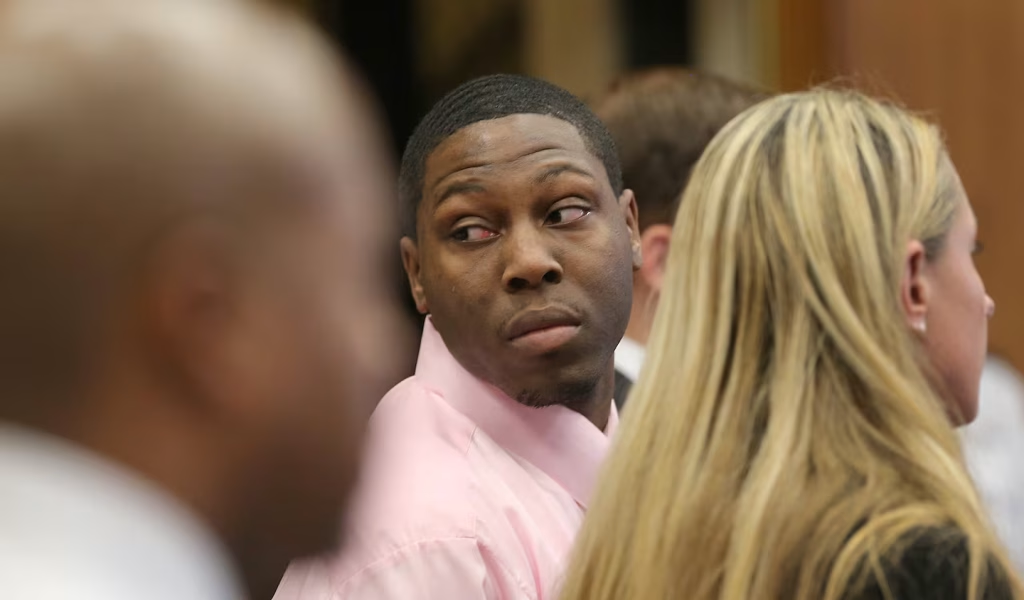
Sheldon Mattis was 18-years-old when he handed a gun to his friend, who used it to shoot and kill a 16-year-old in Dorchester in 2011, according to reporting by The Boston Globe. In 2013, Mattis was convicted of first-degree murder and sentenced to the mandatory life without the possibility of parole. His friend, who was 17 at the time, was sentenced to life with the possibility for parole within 15 years, according to reporting by AP News.
In 2014, attorneys representing Mattis challenged the Commonwealth’s ruling on the grounds that “such a sentence is unconstitutional for any individual under the age of twenty-two,” according to court documents.
The appeal was eventually brought before the highest court in the state and on Feb. 6, 2023, the SJC will hear oral arguments in the case that could reshape how young adults are sentenced for serious crimes.
Follow along for live coverage of Commonwealth v. Sheldon Mattis. Watch here.
1:00 p.m.: What’s next?
Most cases are decided within 130 days of oral argument, according to the SJC.
At 8 a.m. on the day of the decision, the name of the case will be released on X and the full text of the opinion will be available at 10 a.m. on the New Opinions webpage, the SJC wrote.
12:55 p.m.: A chance for rehabilitation
“People who commit these kinds of serious crimes at this age are capable of rehabilitation. They’re capable of truly transforming themselves into extraordinary people people who’ve already given back to their society from inside prison and have so much more to give back outside of prison,” Schiff concluded.
12:50 p.m.: How many first-degree murder cases could be affected?
According to Schiff, around 203 cases could be affected by a potential Mattis ruling.
“Those are people who got really long sentences without these important issues being taken into account,” he said. “I think it would be a small enough number of cases that it wouldn’t create undue burden on the court.”
12:45 p.m.: Young adults more vulnerable than juveniles?
Schiff argued that the studies show that young adults 18 to 21 are actually more vulnerable than juveniles.
12:40 p.m. Which experts testified?
According to Schiff, the following experts testified in front of the Superior Court about the science of adolescent brain development:
- Lawrence Steinberg, a developmental psychologist
- Adriana Galván, a neuroscientist
- Robert Kinscherff, a forensic psychologist with expertise in recidivism risk prediction
- Stephen Morse, a law professor and forensic psychologist
12:33 p.m.: Should we ‘raise the age for homicide’?
When Schiff reminded the court that the legal drinking age was raised from 18 to 21 to reduce traffic accidents, Cypher asked: “So should we raise the age for homicide?”
12:30 p.m.: Offense vs. offender
Schiff said: “Our argument is not that there’s a disproportionality between the offense and the punishment, but rather between the offender and the punishment.”
12:20 p.m.: What studies are they referring to?
Three years ago, the SJC asked the Superior Court to look into scientific studies in the development of youth after the age of 17, as it is relevant to the Mattis case.
According to previously published court documents, experts said the following could be determined about late adolescents:
- Exhibit a greater degree of risk-taking, sensation-seeking and impulsivity, particularly in circumstances of emotional arousal
- Are more susceptible to peer influence
- Have a greater capacity for change and reformation
12:17 p.m. 18 vs. 21: What determines the cut off?
In response to Schiff’s claim about the neurological differences between teenagers and early adolescents, Associate Justice Elspeth Cypher voiced concern over the reliance on scientific studies done in a lab and their implication on real-world findings.
12: 16 p.m. What we know about Mattis’ first-degree murder charge
Sheldon Mattis, 18, was walking with his friend on Levant Street in Dorchester on a Sunday afternoon in 2011. He allegedly handed a gun to his friend, who subsequently shot and killed 16-year-old Jaivon Blake “as part of an escalating gang feud,” according to court documents.
According to a witness at the scene, Mattis allegedly told his friend,“that’s them walking up there right now” and that his friend “needed to go handle that.” After the shooting, a witness said he saw the two friends “celebrating,” according to court documents.
The pair were arrested that same day. Mattis was sentenced to life in prison without the possibility of parole.

12:15 p.m. Oral arguments begin: Commonwealth v. Sheldon Mattis
Attorney Ryan M. Schiff kicked off oral arguments in the SJC:
“Late adolescents are different than other adults in very important ways that are relevant to sentencing,” Schiff said.

Leave a Reply